
Research
Understanding Varroa Survival
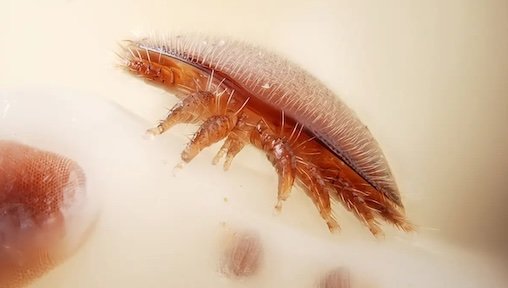
A 2025 study in Apidologie by Parenzan et al. reveals that Varroa destructor mites can survive far longer on honey-bee larvae than previously believed
Read MoreTropilaelaps
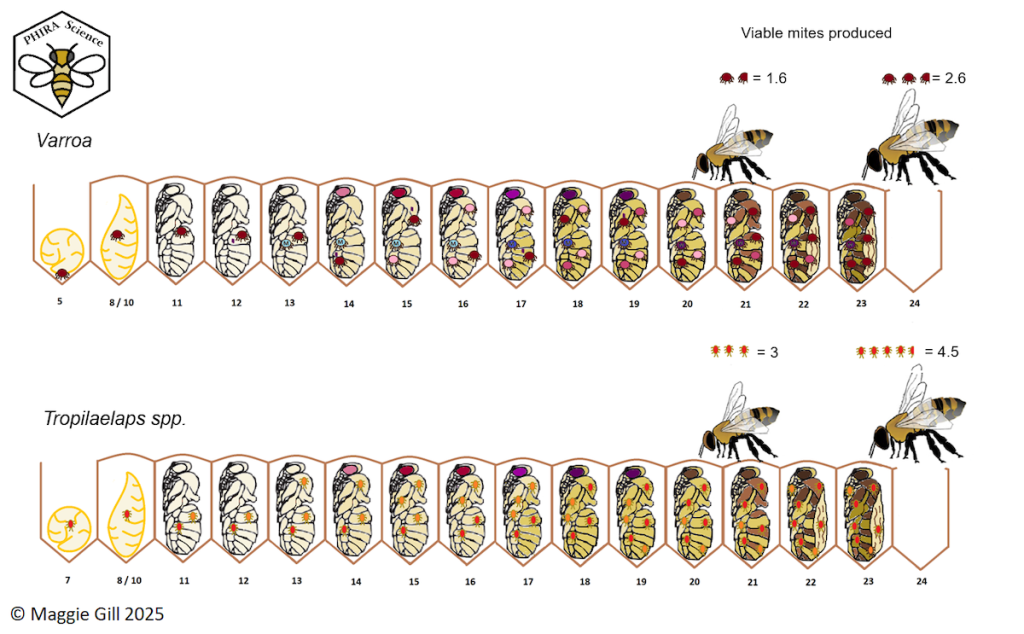 MAGGIE GILL
In areas where both Tropilaelaps and Varroa are present it has been reported that Tropilaelaps are a far more damaging pest than Varroa.
Both Varroa and Tropilaelaps have been shown to vector viruses when they feed and in one study 100% of Tropilaelaps mites examined harboured deformed wing virus (DWV) compared to only 81.8% of Varroa.
Appetitive floral odours prevent aggression in honeybees
Honeybees defend their colonies aggressively against intruders and release a potent alarm pheromone to recruit nestmates into defensive tasks. The effect of floral odours on this behaviour has never been studied, despite the relevance of these olfactory cues for the biology of bees. Here we use a novel assay to investigate social and olfactory cues…
Read MoreTolerance to Varroa destructor in Ireland

In North County Dublin, Ireland, a region that has a relatively self-contained beekeeping regime with little movement of colonies or queens into the area, tolerance (co-adaptation) to varroa mites is becoming established.
Read MoreEstimating C-lineage Introgression

Conservation efforts for A. m. mellifera are underway in multiple European
countries requiring reliable and cost-efficient molecular tools to identify purebred colonies. Here, we developed four ancestry-informative SNP assays for high sample throughput genotyping using the iPLEX Mass Array system.
Is the Dark Bee Really Native to Britain and Ireland?
This article by Dorian Pritchard was originally published in BIM 30 Winter 2008
Read MoreBreeding for resistance to Varroa destructor in Europe
The rich variety of native honeybee subspecies and ecotypes in Europe offers a good genetic resource for selection towards Varroa resistance.
Read MoreWork with Bangor University

North Wales BIBBA groups have teamed up with South Clwyd Beekeepers and Bangor University.
The first study by Bangor concerned a survey of bee wings throughout South Clwyd. The wings were analysed using DrawWing and Morphplot. The samples were collected by BIBBA breeding groups and members of SCBKA and then tested by a number of BIBBA queen rearers and the Bangor researcher Elise Keller.
New Approach to the Mitotype Classification
The main problem of the black honeybee in Russia and European countries is the preservation of the indigenous gene pool purity; A new approach to the classification of the honeybee M mitotypes was suggested.
Read MoreNeonicotinoids and Bumblebees
Professor Dave Goulson – Bees, Pesticide and Politics: the impact of neonicotinoids on UK bumblebees
Read More