
Water Dynamics
Pierre Le Bivic et al. (2026) published an article in the Journal of Insect Physiology that described the findings of an experiment where they set out to understand the water utilisation of a honey bee colony in the higher temperatures which we seem to be having to handle in our summers and springs. The result was a surprise.
Why the colony needs water
Water is mainly used for larval jelly production by the worker bees and is an essential component of the food supply. Without the water, there will be no food for the new larvae to consume and the colony will reduce in size. Water is also used for thermoregulation of the hive. Beekeepers know about the latter because it is frequently mentioned and described. But not everyone immediately thinks of the need for water to create the larval food supply.
Tracking water through the hive
By doping water fed to the bees with a weak solution of deuterated water, a stable isotope, the movement of water within the hive can be assessed using standard assay techniques, and the dynamics and turnover rate of water can be determined.
The most interesting part of the study was to see how the ambient temperature affected the water turnover rate and the amount of water used for larval jelly production and thermoregulation. They found that the water loss rate for bees was lower than for other insects that also have high-water-consumption diets.
What changes as temperatures rise?
The biggest change in the findings was how water usage shifted during temperature rises.
At 32°C, 80% of the water collected each day was consumed by the bees. Above 37°C, water use changed: 50% was used by the bees, with the rest being used for thermoregulation. The amount being collected was limited by the bees, which presumably could not manage to collect any more water without more bees being active water carriers. The implication is that the high temperatures will start to regulate the brood-generating capacity of the colony, and sustained high temperatures could be causing a ‘hold’ in colony development.
Reading the figures
The illustrations from the paper cited show the amount of water consumed. The horizontal axis is the maximum daily temperature. The vertical axis is the percentage of daily water collection used for each of the three targets.
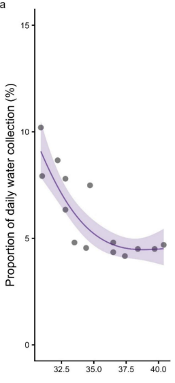
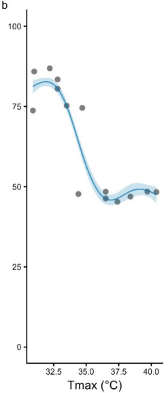
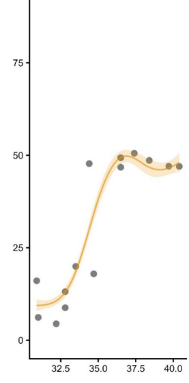
Figures (a–c). Proportions of daily water collection allocated to three uses in relation to maximum daily temperature. Source: Le Bivic et al. (2026), doi:10.1016/j.jinsphys.2026.104987.
Graph (a) is the water collected for production of worker jelly. Graph (b) is the water consumed by the bees themselves; this could be either in urination or in allowing water to evaporate from nectar being held in the mandibles as part of the honey production process. Graph (c) is the amount of water presumed to be used for thermoregulation.
A limit to cooling?
It is clear from graph (c) that a limit has been reached. Is this because there are not enough bees to evaporate more water, or is there a shortage of water, or perhaps a lack of bees to collect water?
We do not yet know the answers to this conundrum, but it would be wise for us to make sure that there is always plenty of water close to the hives, so that they do not have to use too much energy collecting it and do not run out. But would a stronger colony fare better? One day, more research will give us the answers.
The message for beekeepers
The message is clear: the higher temperatures are making it more difficult for our bees. Keep the colony in cooler spots, ensure there is plenty of shade over the hive and preferably choose a breezy location to take the heat away. Sitting in the hot sun is going to cause the bees to end up inside a colony that has maxed out its thermoregulation water supply.
Reference
Le Bivic, P. et al. (2026). Journal of Insect Physiology. https://doi.org/10.1016/j.jinsphys.2026.104987