
CONTENTS
- Winter Course 2026/27
- Can Bees Smell Varroa Resistance?
- Clearer origin labelling planned for honey sold in Britain
Winter Courses 2026-27
As the active beekeeping season has closed, winter is the perfect time to review what you have done in the past, perhaps consider what you may have learnt from mistakes and plan for a more successful coming season. To help you, this winter BIBBA is running two practical one-day courses on the same weekend across nine UK locations. Led by two well-known experienced, practical beekeepers Karl Colyer (Cheshire) and Roger Patterson (West Sussex), these sessions are packed with good, sound information that is intended to help beekeepers manage their apiaries more efficiently and with better understanding.
“Early Years” Designed for those moving past their initial training. If you've just survived the hectic learning curve of your first few seasons, this day will map out how to shift from reactive troubleshooting to managing your colonies with knowledge and confidence.
“Sustainable Bees and Queens for Everyone” Suitable for all experience levels. With growing concerns around the risks of imported bees including pests, disease, and unpredictable aggression, this wide-ranging course focuses on how you and your local BKA can raise robust, locally adapted bees and queens suited to our fickle climate.
The nine venues are Warwickshire, Essex, South Yorkshire, Nottinghamshire, Scotland, Cheshire, South Wales, Northumberland and Somerset.
How much is it?
Both courses are free, but please read on. As an educational charity, our goal is to support and educate beekeepers. We want to offer these winter courses completely free to our members.
To protect our charity status and allow us to claim Gift Aid on subscriptions, UK tax rules mean we cannot offer "members-only discounts" against a standard non-member ticket price. Doing so would invalidate the Gift Aid we rely on for part of our income. Therefore, we run these specialised days as exclusive, members-only events, but ask non-members to join so we comply with HMRC rules. For just £15 a year (via Direct Debit, or £25 by other methods), you gain full access to both days of winter learning, plus other benefits for a full year. We think it’s incredible value for a full day (or two!) of tuition.
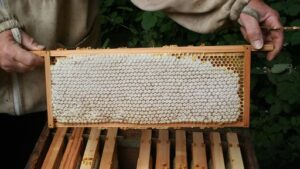
The Early Years
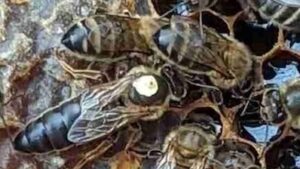
Sustainable bees and queens for everyone
A new way of identifying the colonies we should breed from
For many years, bee breeders have tried to identify colonies with the ability to survive and prosper despite Varroa destructor. We have used measurements of mite infestation, mite reproduction, brood removal and hygienic behaviour. One of the simplest and most popular approaches advocated has been the freeze-killed brood (FKB) test: kill a patch of brood, return it to the colony and measure how quickly the bees remove it.
But there is a fundamental problem: Being good at removing dead brood is not necessarily the same as being good at dealing with Varroa.
A fascinating paper by Wagoner and colleagues, published in the Journal of Insect Science in 2021, explores a potentially much more targeted approach. The researchers asked whether we could stimulate the bees with the chemical signals associated with unhealthy, Varroa-infested brood and use their response as a measure of Varroa resistance.
The smell of unhealthy brood
Honey bees communicate chemically. Developing brood normally has a chemical profile, but that profile changes when brood becomes unhealthy. The researchers identified four compounds associated with Varroa-parasitised or unhealthy brood ((Z)-10-tritriacontene, (Z)-8-hentriacontene, (Z)-8-heptadecene and (Z)-6-pentadecene).
These are cuticular hydrocarbons, chemicals occurring naturally on the surface of insects. The researchers combined the four compounds and applied them to capped brood. They then returned the frame to the colony and measured how many cells the workers uncapped or otherwise manipulated within two hours.
They called this the unhealthy brood odour (UBO) assay. Importantly, the test isn't asking whether the bees remove something that has been killed but something much more relevant:
"How strongly do these bees respond to the chemical signal associated with unhealthy brood?"
That is a potentially much more biologically relevant question for Varroa-resistance breeding.
What did they discover?
The results were striking. Among colonies that had not been treated with miticides in spring, the stronger the UBO response, the lower the subsequent Varroa infestation. The relationship remained apparent even among colonies with relatively low mite levels, suggesting that the test might distinguish the best colonies from merely average colonies that happen to have few mites.
The researchers identified approximately 60% removal/manipulation within two hours as a useful practical threshold. Colonies scoring below 60% were classified as low UBO; those scoring 60% or above were classified as high UBO. The high-scoring colonies had substantially lower subsequent Varroa levels. For example, colonies with high June UBO scores averaged only 1.6% Varroa infestation in August, compared with 7.2% in the low-scoring group. That is a very large difference.
The UBO test also predicted the removal of experimentally introduced Varroa. Most importantly for practical beekeeping, however, it was associated with winter survival. In the untreated population studied, colonies scoring highly in June had an average overwintering survival of 57%, compared with 21% for low-scoring colonies. For August testing the figures were 65% and 24%, respectively.
The message for the breeder is therefore quite powerful: A two-hour behavioural test appeared to tell us something about a colony's ability to live with Varroa several months later.
Why might this be better than the freeze-killed brood test?
The FKB test remains useful and has an established place in hygienic-behaviour selection. But it measures a fairly general response to dead brood. The UBO test is different. It attempts to mimic one of the actual chemical signals that causes bees to recognise compromised brood.
The researchers found that UBO and FKB scores were correlated, but the UBO test was a better predictor of Varroa infestation. In their data, colonies with high UBO scores averaged 1.6% Varroa in August, while high-FKB colonies averaged 3.2%. Only the UBO classification consistently separated colonies with substantially lower mite loads.
For bee improvement, this distinction matters enormously. If our objective is to breed Varroa-resistant bees, we should ideally select on traits that are actually connected with Varroa resistance - not simply on a related characteristic.
What does this mean for BIBBA members?
The most exciting possibility is that a relatively simple assay could become another tool in a breeder's selection programme. Imagine testing 20 colonies in June. Rather than simply recording which colonies look strong, produce honey or have a good brood pattern, we could add a measurement of their response to unhealthy brood signals.
The breeder might record: Queen → UBO score → Varroa level → brood pattern → temperament → productivity → winter survival
Over several years, patterns could emerge. The very best queens would not necessarily be the queens whose colonies simply have the lowest mite count on one particular inspection. Instead, we could look for colonies that repeatedly demonstrate an ability to detect and respond to compromised brood while maintaining low Varroa populations.
This is much closer to the philosophy of genuine bee improvement: measure a useful biological trait, select the best colonies, breed from them, and then see whether the characteristic persists in their descendants. There is another particularly interesting implication for BIBBA. The researchers found that the UBO test could distinguish high-performing colonies even where Varroa levels were already below 3%. That could be extremely valuable.
Waiting until a colony has a high mite population before deciding whether it is a good breeder is rather like selecting sheep for disease resistance only after they become seriously ill. The more sensitive our measurements become, the earlier we can identify potentially valuable genetics.
But don't rush to buy the chemicals
There is an important caveat. This is a promising research finding—not yet a finished field-breeding protocol. The authors themselves identify several unanswered questions. We don't yet know the heritability of UBO performance, nor how the trait relates to honey production, brood pattern or other economically important characteristics. The four chemicals probably represent only part of the chemical signal produced by unhealthy brood.
There is also an intriguing possibility that the response is not exclusively Varroa-specific. Some of these compounds are associated with other forms of disease, including Deformed Wing Virus. The researchers therefore suggest that UBO responsiveness might eventually prove to be an indicator of broader disease resistance. But this has not yet been demonstrated.
There is a practical complication: smoke may interfere temporarily with the bees' ability to detect odours, potentially affecting a two-hour assay.
The bigger lesson
The most important message from this paper is not the four chemical names or even the 60% threshold. It is the direction of travel.
We are moving from selecting bees because they look good, or because they perform a single simple test, towards understanding and measuring the biological mechanisms that enable a colony to survive. The worker bees are already doing the work. They are detecting something about unhealthy brood that we cannot see. The researchers have begun to identify the chemical language involved.
Our job as breeders is to ask a simple question: Which colonies are best at understanding that language - and can we breed more of them?
The answer is not yet complete. But this research suggests that the future of Varroa-resistant bee breeding may depend increasingly on finding better ways of measuring what bees can already do for themselves. That is a very BIBBA idea: understand the bee, measure the bee, select the bee—and let the bee do more of the work.
Feedback from the Scientific & Technical team
We are fortunate that we now have scientific equipment that is able to identify, or at least, help identify, the chemicals given a very small sample. The use of Nuclear Magnetic Resonance machines and the big new mass spectrometers are really powerful tools.
Paul Verrier and Karl Colyer
https://bibba.com/wp-content/uploads/2026/09/Hygiene-Eliciting-Brood-Semiochemicals.pdf
Clearer origin labelling planned for honey sold in Britain
New European Union rules requiring much clearer country-of-origin information on honey labels came into force on 14 June 2026.
Previously, a jar containing honey from several countries could simply be described as a “blend of EU and non-EU honeys”. Under the new rules, the label must identify each country from which the honey was harvested, list the countries in descending order by weight and give the percentage contributed by each one.
Similar requirements are now planned for Great Britain. At present, honey sold in England, Scotland and Wales may still be labelled simply as a “blend of honeys from more than one country”, without identifying any of those countries.
However, the UK Government intends to align British honey regulations with the new EU rules through the proposed UK–EU Sanitary and Phytosanitary Agreement. Government guidance specifically states that blended honey will need to show its countries of origin, in descending order of contribution, together with the percentage supplied by each country.
Northern Ireland has already adopted the new requirements under the Windsor Framework. For Great Britain, the Government currently expects the new arrangements to take effect in mid-2027, although the precise date and any transitional provisions have yet to be confirmed.
The change should allow shoppers to distinguish genuine single-country honey from blends assembled from honey imported from several different parts of the world. It will also remove vague descriptions which provide consumers with very little useful information about where the honey was actually produced.
Greater transparency will not, by itself, eliminate honey adulteration or guarantee authenticity. Nevertheless, meaningful country-of-origin labelling should make supply chains more visible and help consumers make better-informed choices—including choosing honey produced by British beekeepers.
The latest EBA magazine details ideas on preparing for Tropilaelaps: EBA Magazine 27