CONTENTS
Pollen dearth impacts honey bee behaviour and physiology
A recent paper by Elizabeth M. Walsh et al. (2026) looked at how nutritional protein deficiency affected a honey bee colony. A pollen dearth was simulated in one half of their experimental colonies by robbing foragers of their pollen loads, the primary source of protein. The pollen was removed by a pollen trap placed at the entrances to the hives. Temperament assays were then taken of each colony every week, along with the control colonies that were not being deprived of their pollen. At the same time, the plant species that were being foraged were identified and various physiological measures of honey bee nutritional status, including gland size, lipid (fat) levels and gene expression, were recorded in order to further investigate and perhaps explain bee behaviour.
How did the bees respond?
They found that pollen-deprived bees reacted by becoming more defensive and that immature bees likely receive cues during rearing which cause some different gene expressions and ultimately behaviour as adult bees. This suggests that environmental stress caused significant behavioural changes.
Temperament is believed, in the literature, to be primarily associated with genotype (race) of bees, but this work has shown that there are environmental cues that are less acknowledged that affect bee behaviour significantly.
As drought becomes increasingly frequent and the food resource has a temporary dearth, the impact on the behaviour of honey bees will become increasingly noticed.
What does this mean for selection?
For the beekeeper, it is important to understand that, when selecting for breeding queens, the availability of protein (pollen) should be considered alongside temperament. Also, as noted in the accompanying article on water dynamics, the impact of temperature should be noted, as this is another environmental factor that will need to be overcome by any super honey bee we wish to try and breed.
How was defensiveness measured?
It is interesting to note the assay used to determine aggression. A rating was created from observing a colony over two minutes, noting four specific behaviours:
- The degree of stinging.
- The propensity of bees to hang from the comb.
- The running speed across the comb.
- The tendency of bees to fly around the observer.
This assay was conducted at the same time by the same observer one day a week, on the same day.
What the graph shows
The graph is taken from the paper and shows that pollen-deprived colonies had higher defensive assay scores than control colonies.
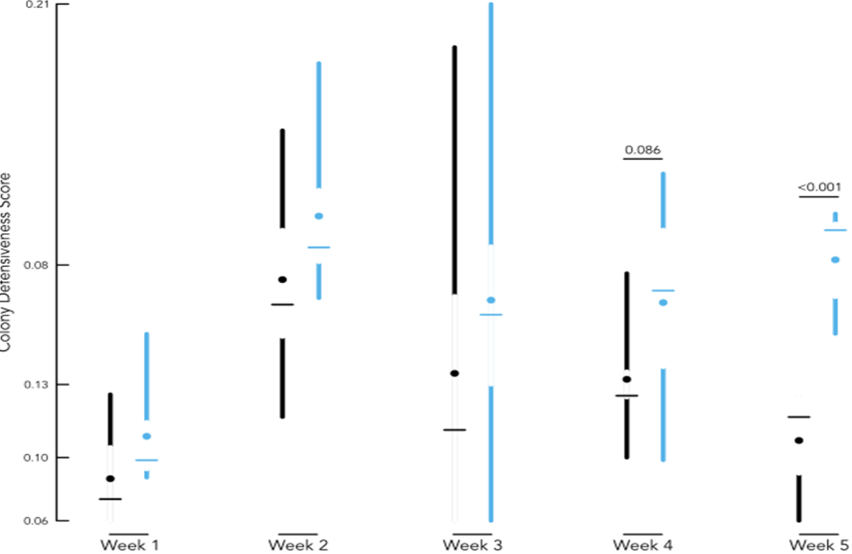
The figure illustrates the distribution of factor scores across the sampling timeline and between control (black) and pollen-deprived (light blue) colonies. Across all observations (N = 75), the x-axis denotes discrete time points and the y-axis provides the defensive score. The y-axis extends from the lowest to the highest score obtained in the data set, and tick marks are made at each quartile. For each group, segments extend from minima to maxima with gaps bounding the interquartile range of the data, circles identify the mean, and horizontal bars identify the median. The reader should consider the median to be the measure they should consider. Trending and significant time points are indicated with the p-value above the week. Pollen-deprived colonies showed a trend towards more aggressive behaviour than control colonies in Week 4. Pollen-deprived colonies were significantly more aggressive than control colonies in Week 5.
The take-home message
The take-home message is that after a few weeks the protein-deprived bees become significantly more aggressive.
The paper went on to identify genes associated with the aggressive behaviour, which will almost certainly be used by future research and for the creation of more tolerant races of honey bees.
Reference
Walsh, E. M. et al. (2026). https://doi.org/10.1371/journal.pone.0338712
Pierre Le Bivic et al. (2026) published an article in the Journal of Insect Physiology that described the findings of an experiment where they set out to understand the water utilisation of a honey bee colony in the higher temperatures which we seem to be having to handle in our summers and springs. The result was a surprise.
Why the colony needs water
Water is mainly used for larval jelly production by the worker bees and is an essential component of the food supply. Without the water, there will be no food for the new larvae to consume and the colony will reduce in size. Water is also used for thermoregulation of the hive. Beekeepers know about the latter because it is frequently mentioned and described. But not everyone immediately thinks of the need for water to create the larval food supply.
Tracking water through the hive
By doping water fed to the bees with a weak solution of deuterated water, a stable isotope, the movement of water within the hive can be assessed using standard assay techniques, and the dynamics and turnover rate of water can be determined.
The most interesting part of the study was to see how the ambient temperature affected the water turnover rate and the amount of water used for larval jelly production and thermoregulation. They found that the water loss rate for bees was lower than for other insects that also have high-water-consumption diets.
What changes as temperatures rise?
The biggest change in the findings was how water usage shifted during temperature rises.
At 32°C, 80% of the water collected each day was consumed by the bees. Above 37°C, water use changed: 50% was used by the bees, with the rest being used for thermoregulation. The amount being collected was limited by the bees, which presumably could not manage to collect any more water without more bees being active water carriers. The implication is that the high temperatures will start to regulate the brood-generating capacity of the colony, and sustained high temperatures could be causing a ‘hold’ in colony development.
Reading the figures
The illustrations from the paper cited show the amount of water consumed. The horizontal axis is the maximum daily temperature. The vertical axis is the percentage of daily water collection used for each of the three targets.
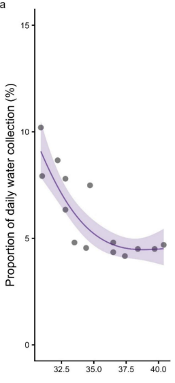
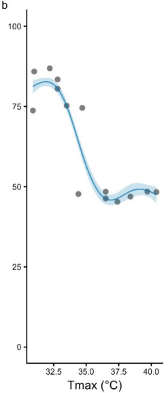
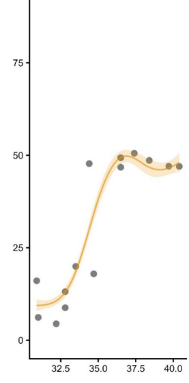
Figures (a–c). Proportions of daily water collection allocated to three uses in relation to maximum daily temperature. Source: Le Bivic et al. (2026), doi:10.1016/j.jinsphys.2026.104987.
Graph (a) is the water collected for production of worker jelly. Graph (b) is the water consumed by the bees themselves; this could be either in urination or in allowing water to evaporate from nectar being held in the mandibles as part of the honey production process. Graph (c) is the amount of water presumed to be used for thermoregulation.
A limit to cooling?
It is clear from graph (c) that a limit has been reached. Is this because there are not enough bees to evaporate more water, or is there a shortage of water, or perhaps a lack of bees to collect water?
We do not yet know the answers to this conundrum, but it would be wise for us to make sure that there is always plenty of water close to the hives, so that they do not have to use too much energy collecting it and do not run out. But would a stronger colony fare better? One day, more research will give us the answers.
The message for beekeepers
The message is clear: the higher temperatures are making it more difficult for our bees. Keep the colony in cooler spots, ensure there is plenty of shade over the hive and preferably choose a breezy location to take the heat away. Sitting in the hot sun is going to cause the bees to end up inside a colony that has maxed out its thermoregulation water supply.
Reference
Le Bivic, P. et al. (2026). Journal of Insect Physiology. https://doi.org/10.1016/j.jinsphys.2026.104987
The Early Years