CONTENTS
- Varroa Resistance in Australia?
- Old Comb, New Potential: Why Regular Comb Replacement Matters
Varroa Resistance in Australia?
I have been having several interactions with an Australian beekeeper. He came over to spend time with Steve McGrath during the summer and he’s communicating out the benefits of searching for VR rather than treating bees in Australia.
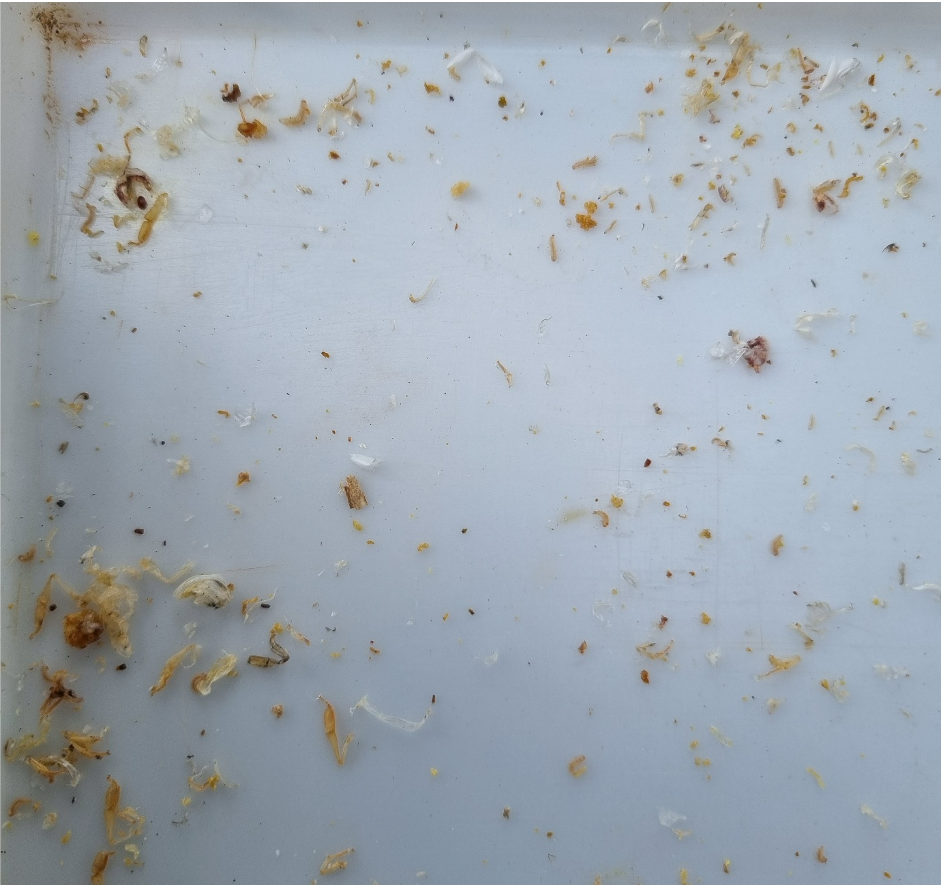
Yesterday, he sent some photos showing exoskeletons on his hive floors. He has found these in one of his hives so far and he’s really excited about the possibilities this offers him. Up until now, he had never noticed exoskeletons because he never looked for them.
Australia has lost around 300,000 colonies since Varroa came to the country. Some of this was down to early colonies being exterminated to try to stop the spread. The current government approach is to chemically treat. Jim and others have the foresight an forethought to potentially leapfrog forward three decades (compared to the UK) and instigate a movement toward breeding for Varroa resistance.
A beekeeper can select a queen. A group of beekeepers can influence a population. They identify their best colonies, share records, breed daughters from promising queens and deliberately maintain good drone-producing colonies. We have spent decades learning how to chemically control Varroa. The next decade could be about breeding bees that can control it themselves. We are moving from an age of treatment to one of selection
Karl Colyer
What scientific research tells us about comb age, colony performance and the practical benefits of replacing old brood comb.
For many beekeepers, replacing old brood comb is one of those jobs that is easy to postpone. If the comb is still intact, the bees are using it, and the colony appears healthy, why go to the trouble and expense of replacing it?
However, the comb in which our bees rear their brood is more than a convenient structure. It is an integral part of the colony’s environment, and its age may influence the performance of the bees developing within it.
A scientific paper by El-Kazafy A. Taha and Saad N. Al-Kahtani, published in the Saudi Journal of Biological Sciences in 2020, provides some useful evidence for beekeepers considering the benefits of regular comb renewal. Their study investigated the relationship between comb age and several measures of colony performance, including foraging activity, pollen collection, brood production, colony population and honey yield. The results provide a compelling reason to make comb renewal a routine part of good colony management rather than a job that is continually put off until another season.
What happens to old comb?
Freshly drawn beeswax is pale, but brood comb gradually darkens as it is used. Each successive generation of bees leaves behind material associated with larval development and pupation. Pollen residues, propolis and other accumulated substances also contribute to changes in the comb. Over time, the cell walls become thicker and the usable cell space can become smaller. The study’s authors explain that accumulated cocoons and other larval and pupal residues contribute to this process. Beeswax can also absorb materials from its surroundings, meaning that older comb may contain accumulated contaminants.
This is not simply a cosmetic change. The comb provides the environment in which the next generation of workers develops, so changes in its structure and composition may have consequences for the colony. The important question is whether these changes are associated with measurable differences in colony performance. Taha and Al-Kahtani set out to investigate precisely that.
Putting comb age to the test
The researchers selected 20 colonies of hybrid Carniolan honey bees, each initially containing approximately 14,000 bees across seven combs. The colonies were brought to broadly similar starting strengths and requeened with newly mated sister queens.
The colonies were then divided into four groups, with each group receiving comb that was one, two, three or four years old. Five colonies were included in each group. The researchers monitored the colonies during the summer and autumn of 2017, measuring returning foragers, pollen-carrying workers, stored pollen, sealed worker brood, colony population and honey production.
This experimental design allowed them to investigate how comb age was associated with colony performance while keeping several other important variables as similar as possible.
It is worth remembering that this was a relatively small study, involving one bee type, one location and particular seasonal conditions. We should not assume that every result will translate directly to every British apiary. Nevertheless, the differences reported were statistically significant and deserve our attention.
The results: younger comb, stronger performance
The study found that colonies on one-, two- and three-year-old comb generally outperformed those on four-year-old comb across all the principal measures investigated. The results for honey production are particularly easy to understand.
Honey yield by comb age
| Comb age | Average honey yield per colony |
|---|---|
| 1-year-old comb | 5.25 kg |
| 2-year-old comb | 4.90 kg |
| 3-year-old comb | 4.65 kg |
| 4-year-old comb | 4.45 kg |
Colonies on one-year-old comb produced an average of 5.25 kg of honey, compared with 4.45 kg for colonies on four-year-old comb. That is a difference of 0.80 kg per colony, or approximately 18% more honey relative to the four-year-old-comb group. The difference may appear modest when considering a single colony, but it becomes more meaningful when multiplied across an apiary. It is also important to recognise that the figures are specific to the study’s conditions, rather than a promise of the same increase in a British season.
The findings extend well beyond honey production.
1. Greater foraging activity
Colonies on one-year-old comb recorded an average of 66.4 returning workers per minute, compared with 59.2 for colonies on four-year-old comb. The researchers also counted workers returning with pollen loads. The one-year-old-comb colonies recorded 19.85 pollen-carrying workers per minute, compared with 16.95 in the four-year-old-comb colonies. These differences suggest that the younger-comb colonies were supporting greater foraging activity, including the collection of pollen needed to rear brood.
For a beekeeper, this is an important distinction. A colony is not productive simply because it has a large number of bees; it also needs sufficient workers actively gathering the resources required to sustain and expand the population.
2. More pollen stored
The colonies with younger comb stored significantly more pollen than those with four-year-old comb. The advantage was approximately 19.7% for one-year-old comb, 13.1% for two-year-old comb and 7.8% for three-year-old comb.
Pollen is a vital protein source for developing larvae and young adult bees. The study found a strong positive relationship between the number of returning pollen carriers and the area of pollen stored. This reinforces the connection between foraging activity, food reserves and the colony’s capacity to rear its next generation.
3. Increased brood production
One of the most interesting findings concerned sealed worker brood. Compared with colonies on four-year-old comb, those on one-year-old comb produced approximately 23.7% more sealed worker brood. The advantage was 17.4% for two-year-old comb and 7.3% for three-year-old comb.
More brood does not automatically guarantee a stronger colony: the queen’s laying performance, food availability, adult bee population, disease pressure and season all matter. Nevertheless, the study suggests that comb age may be one of the factors influencing the amount of worker brood produced.
4. Larger colony populations
The researchers estimated the largest colony population in the one-year-old-comb group at approximately 20,000 bees, compared with 18,000 in the four-year-old-comb group. The two-year-old-comb group averaged approximately 19,200 bees.
These findings fit together logically. More successful brood rearing can produce more adult workers, and a larger workforce can collect more pollen and nectar, provided suitable forage is available. This, in turn, can help support further brood rearing.
The researchers found strong positive correlations between several of these measurements, including sealed brood area and colony population. The results therefore suggest that comb age may influence several connected aspects of colony performance, rather than just one isolated measure.
Why might younger comb make a difference?
The study’s authors discuss several possible explanations. First, the accumulation of cocoons and other residues progressively changes the internal dimensions of brood cells. They refer to earlier research indicating that workers reared in newer comb can be larger than those reared in older comb. Worker size can matter because workers undertake many different tasks, including brood care, comb building, pollen collection and nectar gathering. However, the study does not establish that differences in worker size alone explain the observed changes in colony performance.
Second, the physical and chemical characteristics of old comb change over time. As well as becoming darker and more compact, wax can accumulate substances from repeated use. The paper notes that contaminants may contribute to these changes, although this particular experiment did not identify specific contaminants as the cause of poorer performance.
Finally, colony performance is interconnected. If younger comb supports greater brood production, this may lead to a larger adult population, more foragers and greater food collection. These factors can reinforce one another.
We should be careful not to interpret the study as proving that every old comb is harmful or that replacing comb alone will overcome other problems. It does, however, provide evidence that comb age is a worthwhile management consideration.
What does this mean for BIBBA members?
For those of us interested in hardy, productive bees and sustainable beekeeping, frame renewal is a practical management measure worth incorporating into our normal routine. It is particularly relevant when selecting colonies for breeding and assessing their performance. If we are comparing colonies, we should be aware that differences in comb age may contribute to the results we observe. A colony on substantially older brood comb may not be directly comparable with one using younger comb.
Comb renewal also provides a useful opportunity to inspect the condition of the brood nest, remove damaged or unsuitable frames, and maintain a consistent record of frame age. Marking frames with the year they were drawn or introduced makes this much easier.
There is no need to discard every older frame at once. A planned, gradual approach avoids unnecessary disruption and spreads the work across successive seasons. The study supports the benefits of replacing older comb, but it does not establish a universal replacement interval for every hive or management system. For practical purposes, the aim should be to prevent brood comb from remaining in use indefinitely simply because it still looks serviceable.
A practical tip: renew comb while making a split
One way of making frame renewal part of the normal beekeeping year is to combine it with making a split. Each year, use your three oldest brood combs as the starting point for a split to establish a new colony.
Subject to colony strength, season, queen availability, brood health and adequate food resources, those three older combs can be used to help establish a nucleus or replacement colony. The original colony can then be given suitable replacement frames, allowing the process of brood-comb renewal to continue.
This approach has two benefits:
- It keeps the frame-renewal cycle moving. Rather than waiting until comb becomes excessively old, you remove some of the oldest brood comb every year.
- It gives you the opportunity to produce an additional or replacement colony. Depending on your management objectives, this may help replace winter losses, expand the apiary or provide colonies for sale.
The precise method will depend on the equipment and circumstances. The old comb should be suitable for reuse, and the split must be managed so that both the parent colony and the new unit have an appropriate balance of bees, brood, food and queen provision. Do not transfer comb showing signs of disease or suspected contamination merely to maintain the renewal cycle.
This is not a guaranteed way to increase colony numbers every year regardless of conditions. It is a practical way to combine two jobs that many beekeepers need to undertake anyway: renewing brood comb and managing colony numbers.
Conclusion: make comb renewal part of good husbandry
The research by Taha and Al-Kahtani gives us a useful evidence-based reason to pay closer attention to the age of our brood comb. In their experiment, colonies on younger comb showed greater foraging activity, stored more pollen, produced more sealed worker brood, developed larger populations and yielded more honey than colonies on four-year-old comb. We should not expect identical results in every apiary, but the overall pattern is clear enough to justify a planned approach to frame renewal.
For BIBBA members, there is an additional opportunity: by incorporating the removal of older brood comb into an annual split, we can maintain a more deliberate renewal cycle while helping to create replacement colonies. Rather than treating old comb as something to deal with when it becomes a problem, we can make its replacement part of the routine management of healthy, productive colonies.
Reference
Taha, E.-K.A. and Al-Kahtani, S.N. (2020). The relationship between comb age and performance of honey bee (Apis mellifera) colonies. Saudi Journal of Biological Sciences, 27, 30–34. https://doi.org/10.1016/j.sjbs.2019.04.005
The Early Years